Grok 4.6: Capabilities, Benchmarks, and Current API Pricing
Grok 4.6 is a 500K-context xAI model for coding and agentic work. See xAI's current short- and long-context pricing and what published benchmark comparisons can show.
 Lucky YaduvanshiRankLLMs Editorial
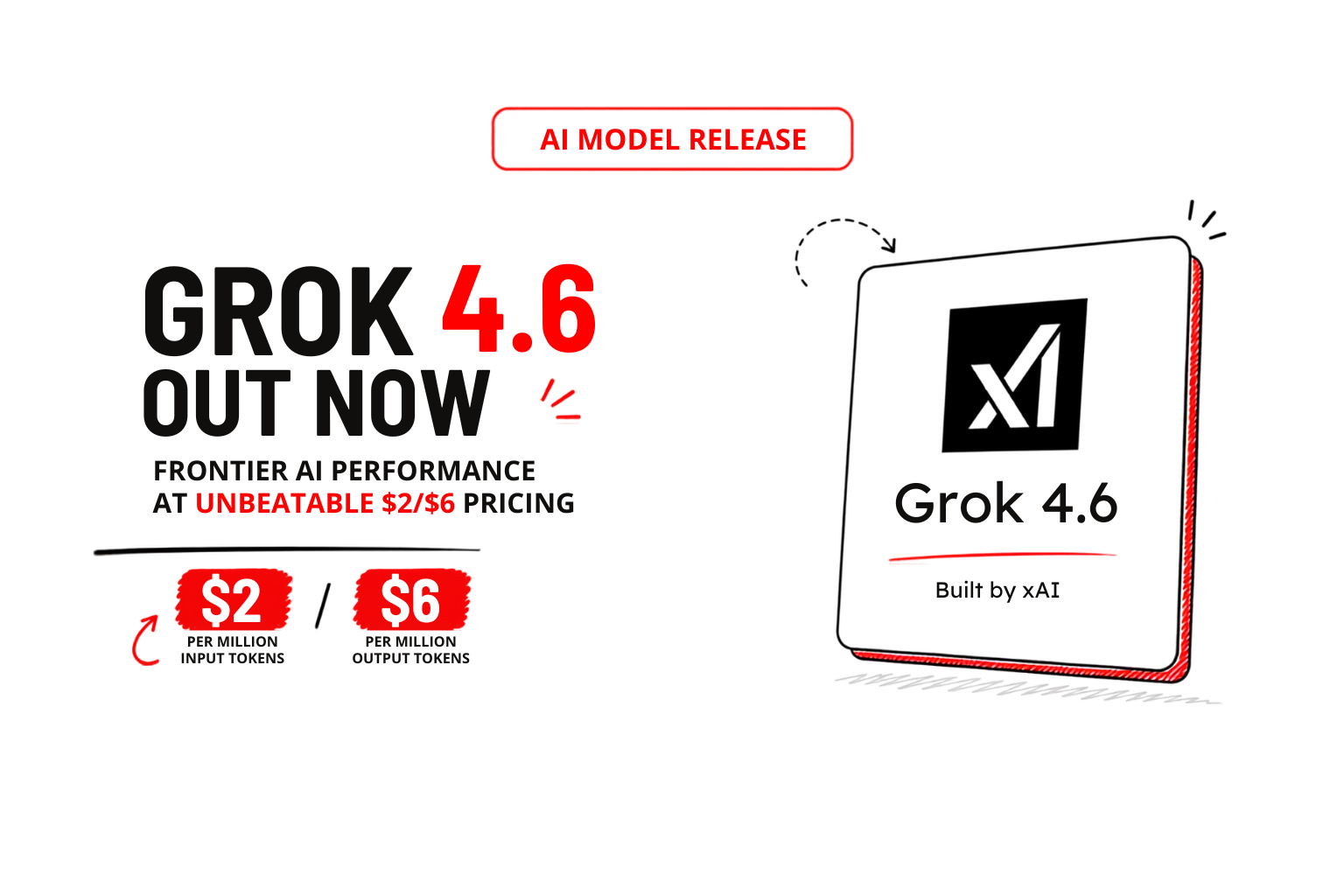
Grok 4.6 is a 500K-context xAI model for coding and agentic work. See xAI's current short- and long-context pricing and what published benchmark comparisons can show.
Written and checked by the RankLLMs editorial team. See theeditorial policy.
Grok 4.6 is SpaceXAI’s model for coding, agentic tasks, and knowledge work. The xAI model page lists a 500,000-token context window, text and image input, text output, function calling, structured outputs, and configurable reasoning. xAI’s August 12 announcement describes it as an update focused on long-running agents and says it matches GPT-5.6 Sol on the Artificial Analysis Intelligence Index.
That announcement is a vendor report, and the Artificial Analysis score is a composite across defined evaluations. Benchmark results are useful evidence about a particular setup, but they do not predict every coding or knowledge-work task. Comparisons should use the same benchmark version, model setting, tools, and evaluation rules.
Current API pricing
xAI’s current pricing page separates requests below and above 200,000 prompt tokens. Prices are in USD per million tokens:
| Token type | Prompt below 200K | Prompt at or above 200K |
|---|---|---|
| Input | $2.00 | $4.00 |
| Cached input | $0.50 | $1.00 |
| Output | $6.00 | $12.00 |
These are standard global rates shown on the xAI pricing page. Regional endpoints and priority processing can have different rates. Check the live page and your team’s account details before estimating a workload. A cached-input rate applies only to tokens xAI bills as cache hits; do not assume all repeated prompt text will be cached.
For a workload of requests that each stay below the long-context threshold, aggregate usage of one million cache-miss input tokens plus one million output tokens would cost $8 at the listed standard rates before other factors. The same aggregate token volumes billed entirely at long-context rates would cost $16. These are totals across requests, not a one-million-token prompt, which would exceed the documented context limit. Real requests contain different input and output volumes and may include cached input, so calculate each component separately.
Reading the benchmark evidence
Artificial Analysis published an evaluation of Grok 4.6 that includes its Intelligence Index and several task-specific evaluations. In that analysis, benchmark versions and methodology are stated for each result. xAI’s release also presents selected comparisons against other models. Those sources support a limited conclusion: Grok 4.6 is positioned for agentic coding and knowledge work, and it performs competitively on some published evaluations. They do not establish a single winner across all tasks or prove a general improvement percentage over Grok 4.5.
For practical selection, test the model with the same coding agent, repository, task set, and success criteria you plan to use. Do not infer a specific training focus or production failure rate from benchmark scores alone.
Where it may fit
The combination of tool calling, structured outputs, and configurable reasoning can suit applications that need a model to work through multistep tasks or interact with tools. The 500K context is an upper limit rather than a guarantee that long prompts are fast, inexpensive, or equally accurate. If tasks exceed 200K prompt tokens, budget with xAI’s higher long-context rates.
For code work, compare Grok 4.6 against alternatives on representative issues and record completion rate, retries, tool errors, latency, and total token cost. For knowledge work, define how you will score citations, factual accuracy, and task completion. A model’s API price alone is not its cost per successfully completed task.
Related resources
- Grok 4.6 model profile
- LLM Comparison Engine
- AI Model Leaderboard
- Best LLM for Coding guide
Takeaway
Grok 4.6’s current API docs give developers a clear 500K context limit and differentiated rates for long prompts. Published evaluations position it as a competitive agentic model, but score comparisons need matched benchmark versions and settings. Verify prices for the endpoint you use, and evaluate quality on your own tasks before extrapolating from a headline score.
Frequently Asked Questions
What is Grok 4.6?
Grok 4.6 is SpaceXAI's model for coding, agentic tasks, and knowledge work. The API documentation lists text and image input, text output, reasoning options, and a 500,000-token context window.
How much does Grok 4.6 cost?
For prompts below 200K tokens, xAI lists $2 per million input tokens, $0.50 per million cached input tokens, and $6 per million output tokens. For long-context requests, the listed rates are $4/$1/$12.
What benchmarks does Grok 4.6 lead?
xAI reports that Grok 4.6 matches GPT-5.6 Sol on the Artificial Analysis Intelligence Index and describes results across agentic coding and knowledge-work evaluations. Scores depend on evaluation versions and setup; no single benchmark makes a model best for every use.
Does Grok 4.6 have a 500K context window?
Yes. The xAI API documentation lists a 500,000-token context window. Requests beyond 200K prompt tokens use higher listed token rates.
Source links for data and claims discussed in this article are listed below. Refer to each source for its current figures and methodology.
- •SpaceXAI Grok 4.6 model documentation(source)
- •SpaceXAI API pricing(source)
- •SpaceXAI Grok 4.6 announcement(source)
- •Artificial Analysis Grok 4.6 evaluation(source)
Lucky Yaduvanshi(luckyyaduvanshi.in →)
Founder of RankLLMs • AI Researcher & Software Engineer focusing on LLM benchmarking, DevOps, and autonomous coding agents.
Recommended Reading
Related by topic and recency.
DeepSeek V4 Pro 0813: Architecture, API Pricing, and Deployment Limits
DeepSeek's V4 Pro report describes a 1.6T-parameter MoE model with 49B active parameters. Current API pricing varies by peak and off-peak periods; see the rate card and deployment caveats.
Qwen3.8 Flash vs GLM-5.3 Flash: Lightweight Frontier Coding Comparison
Compare endpoint compatibility, documented GLM-5.3-Flash pricing, and a fair task-based evaluation plan for Qwen3.8 Flash Next.
NVIDIA Nemotron 3.5 Lightning: Architecture, Benchmarks, and Hardware
NVIDIA Nemotron 3.5 Lightning is a 30B MoE model with 3B active parameters and up to 1M context. Review its published benchmark results and checkpoint-specific hardware guidance.